Recruiting and Staffing Law Firm Pricing and Project Management Roles

Please join me and top recruiter Steve Nelson of the McCormick Group as we present our second webinar in a series on identifying and hiring the right talent for your pricing and project management roles: Putting All the Pieces Together. We'll focus primarily on law firm roles but the discussion will also be relevant to to in-house legal departments, as there are similar challenges.  What skill set is best equipped to drive innovative pricing discussions in your firm?  Some firms seek a trainer to help the partners better understand alternative fee models and when they apply.  Others are looking for a business analyst who can crunch numbers.  Still others desire a client-facing executive who can interact directly with the client's finance and operations counterparts in order to better connect the dots.  It's the same challenge for project management:  Some firms seek a heads-down manager to capably monitor a project plan and keep the team on track.  Others seek a firm-wide resource who can educate lawyers about this new skill.  And there are numerous variations on this theme. Additional issues to be covered include:

--Status of project management programs in the AmLaw 200

--The importance of doing a project management audit

--What training do your existing lawyers and administrators need before embarking on a legal project management program?

--The interaction between project management and alternative pricing, particularly from a staffing point of view

--How does project management fit into your organizational chart?

--Where do your project management professionals need to reside? Issues of geography and relocation

Please join us on February 4, 2014 at 1 PM ET for the on-hour interactive webinar.  For more details and to register, click here.


Timothy B. Corcoran delivers keynote presentations and conducts workshops to help lawyers, in-house counsel and legal service providers profit in a time of great change.  To inquire about his services, contact him at +1.609.557.7311 or at tim@corcoranconsultinggroup.com.

OnRamp Fellowship Launches

My friend, fellow Fellow of the College of Law Practice Management and occasional collaborator, Caren Ulrich Stacy, has launched a new initiative - the OnRamp Fellowship - with the goal of increasing gender diversity in law firms.  The Fellowship is a re-entry platform that matches women lawyers returning to the profession with law firms for a one-year, paid training contract.  The program allows women an opportunity to demonstrate their value in the marketplace while broadening their experience, skills, and legal contacts. Law firms benefit by gaining access to a group of highly-talented, diverse lawyers who want to return to and advance in the profession, particularly into leadership roles.

"These women were highly sought after when they graduated from law school, and they should be again," says Caren Ulrich Stacy. "The first goal is just to bring more women back into the fold. The second goal is to find women who have the potential to advance." (AmLaw Daily "New Fellowship Aims to Restart Dormant Legal Careers."

In addition to the training provided by the law firms, additional contributors have donated their time and expertise to the Fellowship to provide individual coaching and training classes in areas such as business development, public speaking, management skills, negotiations and numerous other topics.  I am pleased to be participating in the initiative by offering training on pricing and project management, critical skills necessary for delivering client value.  The several dozen other contributors (here) represent a who's who of thought leadership in today's changing legal marketplace.

There are four law firms participating in the pilot program: Cooley, Baker Botts, Sidley, and Hogan Lovells.  Applications and interviews for the initial Fellowship are underway and selections will be made by March of this year, with a start date in May.  For more information, visit the OnRamp Fellowship site or view the American Lawyer article here.


Timothy B. Corcoran delivers keynote presentations and conducts workshops to help lawyers, in-house counsel and legal service providers profit in a time of great change.  To inquire about his services, contact him at +1.609.557.7311 or at tim@corcoranconsultinggroup.com.

A Look Ahead for the Legal Marketing Association in 2014

In a few short weeks I take the helm as President of the 3,400+ member strong Legal Marketing Association. Legal Marketing AssociationI could not be more proud to have been elected to lead LMA, a family in which I have been actively involved for nearly 18 years. Just as each of my esteemed predecessors has faced a fast-moving marketplace, I too step in during a time of great change. I'm quite fond of change, however, and I strongly believe the enormous structural and financial changes taking place in the legal marketplace are good for the legal profession, and provide an excellent growth opportunity for the legal marketing profession and the Legal Marketing Association. The current and outgoing Legal Marketing Association president, Aleisha Gravit, conducted a short Q&A with me in her final column of Strategies, LMA's flagship publication, in which I conveyed my outlook for the organization in 2014 and where the legal marketing profession is headed.

Q. Tim, as incoming president, what are the primary goals for LMA in 2014?

A. We must continue to improve both the quality and the access to education for all members, so expect to see more movement on that front. in 2014, we will pursue with vigor new opportunities for collaboration with and among chapters and city groups, so good ideas can receive a wider audience, regardless of where they’re developed.

Q. What trends are you envisioning in legal marketing during the next five years?

A. Legal marketing is evolving, and the recent creation of an LMA Special Interest Group dedicated to pricing is just one example. we must embrace a wider role, moving upstream from tactical execution to strategic planning and leadership. where this is happening already, legal marketers have proven to be valuable thought leaders and trusted advisers. we must be part of the “what” and “why” discussions and not just part of the “how.”

Q. What advice would you give someone just starting out in legal marketing, say with less than two years of experience?

A. Do not allow yourself to be boxed in by how earlier generations of legal marketers have defined the role. Each successive generation must continue to push the boundaries.

Q. On the flip side, what advice would you give seasoned legal marketers?

A. Seasoned marketers who have earned the trust of their internal clients often have the latitude to master new skills and tackle new challenges. while our world is evolving, our own skills can also evolve. Introducing new ideas to tradition-bound lawyers is challenging, but who better to carry the torch of change than trusted marketers who have learned and embraced and adopted new ideas? 

Q. On a more personal note, what do you do in your spare time?

A. I play a lot of basketball. But my real avocation is raising my two daughters. whether it’s attending their sporting events, attending concerts together, trying new recipes or just enjoying their presence, being a Dad is my favorite activity.


Timothy B. Corcoran delivers keynote presentations and conducts workshops to help lawyers, in-house counsel and legal service providers profit in a time of great change.  To inquire about his services, contact him at +1.609.557.7311 or at tim@corcoranconsultinggroup.com.

I Ain't Gonna Play Sun City

I'm sure there are many people, particularly the younger generation, seeing their Tumblr, news feeds and Facebook walls blow up with Nelson Mandela tributes and who, while recognizing the name, still wonder what's the big deal. We've all read in our history books about some of the heinous treatment of one people by another and because these are history books we get the sense that by and large humanity has evolved past such acts. Sure we hear short snippets in the news of atrocities such as genocide, slavery and ethnic and religious purges taking place today, but they always seems to take place in far off countries and often among people that don't look or act like us so it feels pretty distant. Sadly, this is human nature. I grew up in era where Apartheid was legal in South Africa, and proudly so, at least as characterized by some of its country's leaders. While South Africa was far away and many of its people didn't look like us, many of the leaders spouting support for institutionalized hatred looked a lot like us and spoke our language on the newscasts. With the emergence of cable news and 24-hour news cycles, it was hard to escape the reality that people like us were still pursuing heinous policies against others. During my formative years apartheid moved from being a distasteful policy perpetrated in some far-off land to the forefront of our consciousness.

For many US generations, college has been a place where political activism takes hold and it's no coincidence that some of the most compelling moments in political protests, such as those against the war in Vietnam or those in support of Civil Rights, took place on college campuses. But my '80s college generation wasn't exercised about much. We complained about the labeling of "dangerous" music and our musical heroes produced music videos expressing fear of nuclear war, but for the most part our economy was humming along and we were apathetic. Until apartheid. I can't say that I joined marches or protests against apartheid because I don't recall any being organized at my school, but I can say we cared, and cared deeply.

There are no conversations as fascinating and wide ranging as those that take place in college dorm corridors at 3 AM, punctuated by kids who are invincible, who know just enough of politics and world events to be dangerous and who are still supremely confident that they have all the answers to solve the problems foisted upon us by earlier generations. We would debate apartheid and declare that had we been in charge we would never have allowed it to take root, and if we could have our way now we'd eradicate it, though we didn't know how. These conversations crossed racial, political and socio-economic lines, in part because many of us hadn't yet established our own personal ideologies and selected our lifelong news sources that would comfortably reinforce our own biases. From our business and economics classes we understood that the issues were probably more nuanced than "simple" hatred by one race of another -- and make no mistake, there were business and world leaders and emerging leaders of our own generation supporting apartheid at that time, or at least not condemning it because South Africa served their commercial interests. But for most of us, it was a black and white issue - pun intended, but no disrespect intended.

Our musical idols provided some measure of assistance, by refusing en masse to play Sun City, at that time popular stop on many global concert tours. And we radio station geeks would both play the relevant anthems ("Little Steven" Van Zandt and Artists United Against Apartheid "I Ain't Gonna Play Sun City" comes to mind) and refuse to play music from artists who continued to tour South Africa (I'm looking at you Elton John and Queen, among others) though admittedly our gnat-like memories faded when hot new songs by these artists were released. But to the extent we cared about global politics and human rights in that era, apartheid was the subject of our activism. And Nelson Mandela figured prominently in the conversation.

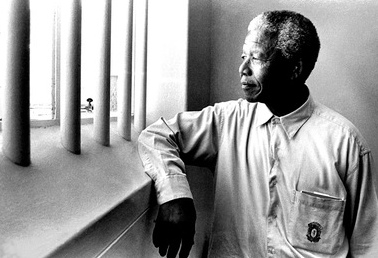
Mandela was released from prison after I graduated, and while the task of earning a living replaced my late night world-problem-solving discussions, none of us could help but be aware, and impressed by, the towering intellect, passion, strength and, yes, compassion, of this man who had spent nearly three decades incarcerated for his stand against his government's injustices. Nelson MandelaLet's ponder that for a second. There are notable movies illustrating how those incarcerated for long periods often struggle with returning to society. And of late there is a seemingly constant stream of wrongly-convicted prisoners released after DNA evidence clears them, typically years if not decades later, and unfailingly the vibrant young people who went to jail emerge as broken shells after a lifetime of imprisonment. And yet Mandela emerged with an unbroken spirit, ready to catalyze the movement to finally ban apartheid. He then led his country after an election in which he earned over 62% of the votes, one of the most stunning reversals of fortune I've observed in my lifetime. He did not act alone. There were, of course, many others, whose names won't be recorded in the history books, fighting apartheid. But Nelson Mandela is not, for me and for many (and hopefully most) of my generation, some distant history book reference; he's the embodiment of what one person can do to fight injustice on a scale that seems impossibly insurmountable.

For that, I am pleased to have been a witness. And I hope my daughters, nieces and nephew, some of whom are of mixed race, and others in the younger generations take a moment to study and reflect on Nelson Mandela's accomplishments (some already have). There's been some muttering about the disproportionate air time devoted to a popular film star who died tragically this week and what an injustice it is that Nelson Mandela's passing isn't generating nearly as much viral attention. I bear no grudge against the media, or the young film fans, who can't get enough news of their deceased movie star. But trust me, when all is said and done, Nelson Mandela, both his life and his passing, will have a far greater impact on our social consciousness than any other news we'll read this week. He was, and is, that important.

He had his failings, as we all do, and we'll begin to hear of his imperfections, and rightfully so. It's important to note that our icons put their pants on one leg at a time just like the rest of us, and have weaknesses just as we have. But that doesn't detract from what he accomplished.

Thank you, Nelson Mandela, for what you've done and for showing us how it's done. Rest in peace.


Timothy B. Corcoran delivers keynote presentations and conducts workshops to help lawyers, in-house counsel and legal service providers profit in a time of great change.  To inquire about his services, contact him at +1.609.557.7311 or at tim@corcoranconsultinggroup.com.

On Bullying

It's a relatively simple mathematical calculation to quantify the negative impact of bullies in the workplace, yet managers in organizations everywhere allow toxic behavior to persist. This week's object lesson comes from the NFL Miami Dolphins, where a professional athlete left the team due to persistent harassment and bullying.

While the full story is not yet known, there are certain unassailable facts: at least one protagonist with a long record of impulsive behavior has acknowledged coercing a teammate into contributing funds to a Vegas vacation, directing ethnic and homophobic slurs at this teammate, and engaging in physical and mental abuse, all in the spirit of hazing -- a long and misguided tradition of veteran players "riding" younger players. The protagonist is not merely a veteran teammate, he's also on the team's leadership council.

There has been a large public outcry leading to the suspension of the protagonist, the victim hiring a lawyer, and the team owner demanding a full investigation. Sadly, but perhaps predictably, the segment of sports punditry comprised of retired athletes has defended the protagonist thusly:  One can't possibly understand what goes on in a locker room unless you're part of the team; the victim walked out on his team during a competitive season, thereby revealing his true character; and the protagonist's actions were merely "boys being boys."

One retired coach called the victim a "baby" and waxed philosophic about "Back in my day when men were men..."  Others accused the victim of gamesmanship, suggesting his failure to report these allegations earlier and his supposed camaraderie with the protagonist demonstrates disingenuousness. In response, the victim acknowledged a fear of retaliation and the loss of his livelihood as reasons for not stepping forward earlier. We'll learn more as this story unfolds, but we know enough to recognize a hostile work environment. Why? Because nearly all of us have witnessed such bullying in our own workplaces.

In the corporate sector, the toxic personality often takes the form of a top-producing salesperson who breaks the rules, fails to properly document activity, over-commits the organization to meeting a client demand, and then bullies colleagues into delivering the impossible because, as the old saying goes, "nothing else matters until we make a sale."

It can also take the form of a long-entrenched manager who has watched leaders come and go, who has watched strategies come and go, who has watched competitors come and go, and all the while she's tending to the company's day to day needs. She truly believes her steady hand on the rudder is the primary driver of organizational success in an ever-changing marketplace, and so when presented with new and uncomfortable ideas her knee-jerk reaction is "We've tried that before and it didn't work. Next!"

In law firm land, the corollary is the toxic partner, that rainmaker bringing in millions in billable hours, or the long-established patron of the corner office whose reputation is unassailable and who can do no wrong. Whether the partner cycles through secretaries like others change their socks, or metes out punitive assignments to associates who fall out of favor, throwing tantrums in the office when the staff fails to read his mind or demanding that others adhere to stringent work requirements out of some vague allegiance to client service, these actions constitute a hostile work environment.

Worse, if the toxic partner is acting under the delusion that such actions will improve team performance, she or he is assuredly provoking the exact opposite outcome. We've all seen the feel-good movies where a tough-as-nails but kind-hearted leader drives his team to victory by forcing everyone to reach deep inside, to unlock that extra courage, to go that extra mile. And there's some truth to that, of course. Any coach knows that even high performers often need external motivation to break through barriers. But how much is too much?

The underlying math in any organization is simple, requiring us to balance the revenue generated with the costs incurred. But too often we fail to complete the equation, focusing solely on the revenue side. So the rainmaker generating millions of billables earns a free pass, or perhaps only an occasional private "talking to" when his conduct falls too out of line. But when we factor in the victims' lost productivity due to distraction or emotional detachment, the cost to continually recruit and train replacements, the sub-optimal work product that results from star performers avoiding collaboration with the toxic partner, the client defections, and more, this "total cost of ownership" will invariably tip the scales in the other direction.

There is NO financial reason to perpetuate a hostile work environment. There is ALWAYS a long-term loss in revenue and profit when such a situation is allowed to persist.  If you've done the math and somehow produce a result that says otherwise, I challenge your approach.

There are protections in place for whistleblowers for a good reason: people often won't speak up for fear of retaliation, because they fear the loss of their income and job security, because they feel they'll be shunned by colleagues for impairing the team's performance. Rather than discourage open talk, we should encourage it. If there's a toxic personality creating a hostile work environment in our workplaces, as managers and leaders we need to step up and address the situation directly and immediately. If you can't summon the courage to do so because it's the right thing to do, then take action because such an environment is unquestionably impairing the team's performance.

Why in the world would you take money out of your own pocket to reward some immature buffoon's temper tantrums or locker room behavior, when the alternative is to excise the annoyance and improve both morale and financial performance? Not every workplace has a toxic personality. But if you have one, or more, take action today.

Epilogue: The Miami Dolphins had a .500 record when the above incidents came to light, meaning their next game would literally put them on the path to a winning record or a losing record. The team lost its next game to a previously winless opponent.

Timothy B. Corcoran is principal of Corcoran Consulting Group, with offices in New York, Charlottesville, and Sydney, and a global client base. He’s a Trustee and Fellow of the College of Law Practice Management, an American Lawyer Research Fellow, a Teaching Fellow at the Australia College of Law, and past president and a member of the Hall of Fame of the Legal Marketing Association. A former CEO, Tim guides law firm and law department leaders through the profitable disruption of outdated business models. Tim can be reached at Tim@BringInTim.com and +1.609.557.7311.